
1.3 Types of Problems
In TDR (Transdisciplinary Research), one objective is to consider the complexity of a problem. We strive to move beyond simplistic problem perception and simple solutions, which we refer to as reductionist.
Such reductionist approaches, which overlook significant system interactions, can lead to unintended and severe consequences for actors and factors that have not been taken into account. Consequently, it is crucial to involve experts from various fields, disciplines, or areas of practice in the research process.
Now, let’s delve into the different types of problems and approaches to tackle them.
| Type of Problem | Definition | Approaches |
| Simple problems | These problems have clear definitions and goals, follow a straightforward process with few steps, and yield predictable results. The necessary knowledge is readily available and can be easily replicated. | Basic methods, established procedures, and disciplinary approaches (if research is required). |
| Complicated problems | These problems also possess clear definitions and goals, but they involve a process with many interdependent steps, often requiring specialised expertise. The results are still predictable, though. | The solution to complicated problems involves a multi-disciplinary or interdisciplinary approach, combining existing methods and expertise. |
| Complex problems | These problems require framing and debating the problem and goals. They involve interdependence among various actors and factors, and the aims, actions, and reactions are contested. The system boundaries may be unclear or shifting, leading to (partially) unpredictable intervention outcomes. | Addressing complex problems requires a transdisciplinary approach, involving iterative processes, combined methods, reflection on methods and process, and deliberation on aims and values. |
| Wicked problems | Wicked problems These problems are characterized by conflicting interests among different groups of actors, making it impossible to find a satisfactory solution for all stakeholders. The solutions obtained are thus partial and temporary. | Tackling wicked problems necessitates transdisciplinary processes, which involve engaging in wider societal debates and mediating between different interests. |
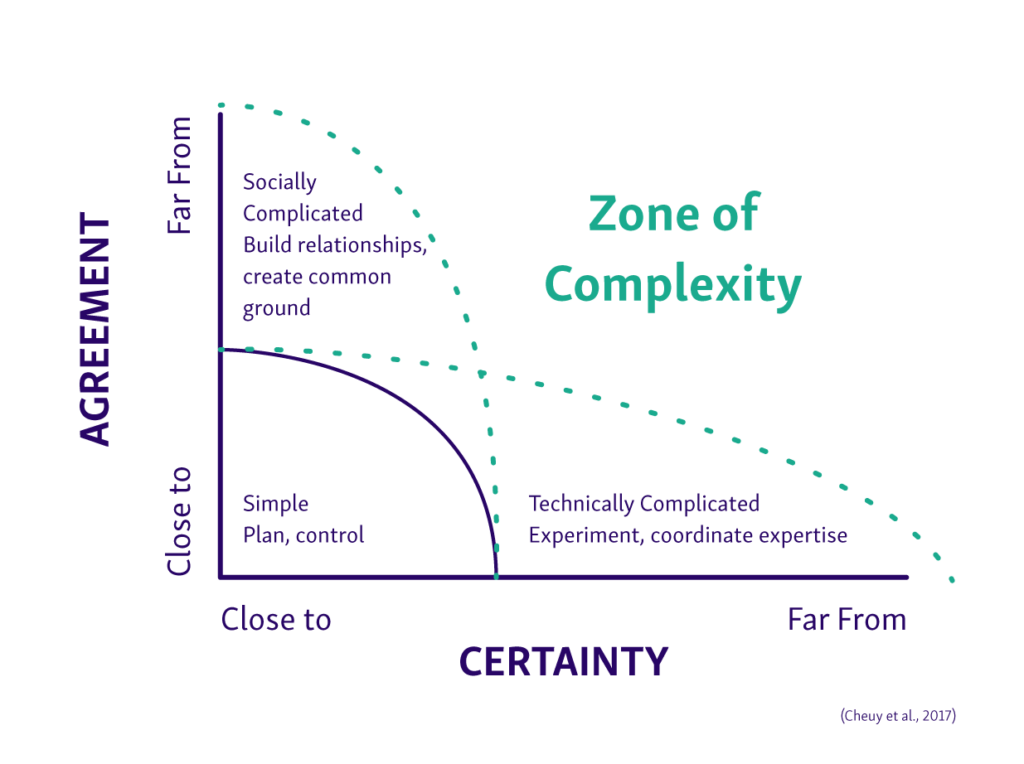
Take a look at the relationship between types of problems, agreement, and certainty. They fall within a zone of complexity.
Various attempts have been made to visually represent these problem types. It is challenging to capture all the elements in a two-dimensional representation; however, the graphic below can help you understand problem complexity.
Infographic Transcript (click to expand)
This graph illustrates the concept of the Zone of Complexity. The image shows an x and y axis, with ‘agreement’ on the y axis and ‘certainty’ on the x axis. Each line is labeled as ‘close to’ and ‘far from’. The area close to agreement and certainty, near the intersection of certainty and agreement, is categorised as ‘simple: plan, control’. The area ‘far from’ the agreement and ‘close to’ the certainty is ‘socially complicated: build relationships, create common ground.’ The area far from certainty and close to agreement is “technically complicated: experiment, coordinate expertise.
| From Cheuy S., Fawcett L., Hutchinson K., Robertson T. (2017) A Citizen-Led Approach to Enhancing Community Well-Being. In: Phillips R., Wong C. (eds) Handbook of Community Well-Being Research. International Handbooks of Quality-of-Life. Springer, Dordrecht. https://doi.org/10.1007/978-94-024-0878-2_8 |